A small board with a large story
On 5 June 2026, Libyan Studies published research by Tim Penn, Corisande Fenwick and Hassan Limane on a gameboard in the medieval hammam at Walila, the settlement associated with Roman Volubilis. The paper brings an everyday activity into the history of a place often approached through its monumental ruins.
The board is carved into a step associated with the bath's cold plunge-pool. Its location gives the researchers a context that an isolated stone would not supply. It is evidence to interpret, not proof of an identical custom in every Moroccan bathhouse.
What the researchers identify
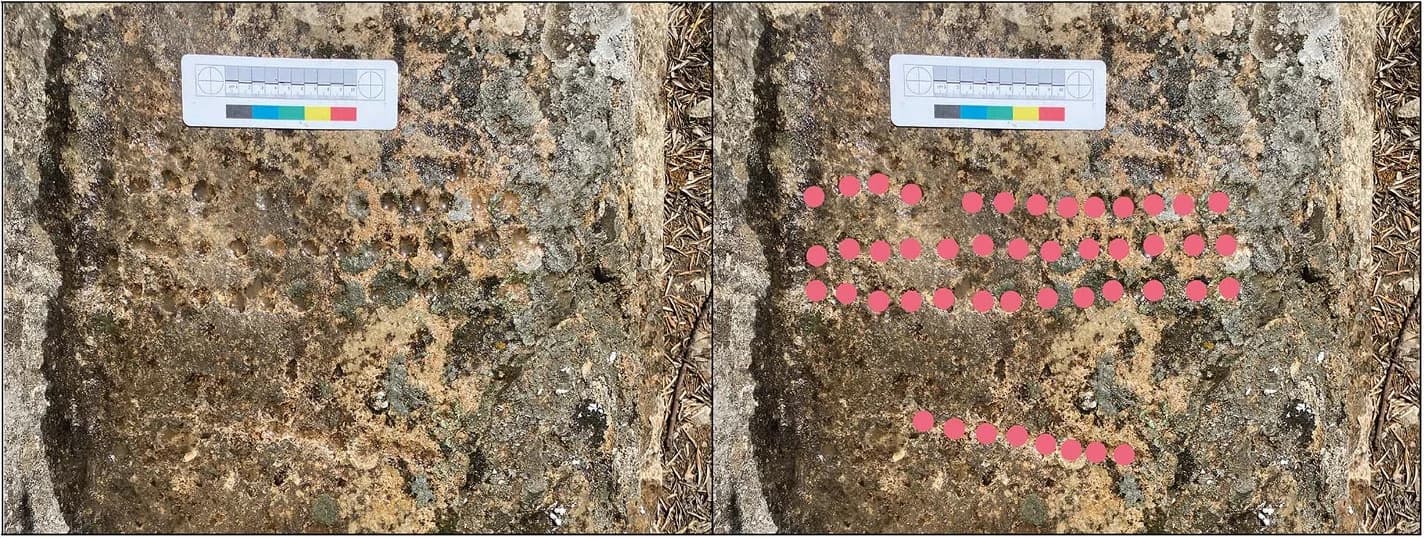
The authors describe three main rows of at least thirteen holes. They suggest the board was used for a form of tab or sig, using comparisons with other boards. The identification is an argued interpretation, not the recovery of a written label or a complete set of rules beside the stone.
Their analysis places the bath's construction in the late eighth or ninth century and its abandonment by the tenth or eleventh. The board's archaeological setting helps narrow its possible date. Do not call it a Roman gameboard merely because the wider site is widely known as Roman Volubilis.
What this changes about the bathhouse story
The finding invites us to think about waiting, meeting and playing alongside bathing. A step is not just circulation space: people could use the building in ways that leave modest but revealing traces.
It also illustrates how archaeological knowledge changes. The gameboard was previously unpublished, not necessarily newly excavated in 2026. A recent paper and a newly discovered object are different claims, and the distinction matters when retelling the story.
Look closely and follow the source
The figure reproduced here shows the photographed surface alongside the researchers' marked positions of the holes. The marks on the right are explanatory annotations; they are not ancient painted decoration. The image is credited to the INSAP–UCL Volubilis Archaeological Project and reused from the open-access paper under its stated licence.
Read the original study for the comparisons and dating argument. This is a story about documented research, not a declaration that the topic is trending or a promise that the archaeological bath is open for bathing today.