A history with several beginnings
The Moroccan hammam belongs to a wider Mediterranean history of bathing, but its story cannot be reduced to a Roman invention copied unchanged. Buildings, washing practices and social expectations developed in different places and periods. Archaeology helps separate that long history from the simplified origin stories attached to modern spa menus.
At Walila, the medieval settlement associated with Roman Volubilis, an early Islamic bathhouse provides evidence from the late eighth or ninth century. Aghmat supplies another important chapter, with its bath dated in published research to the tenth–eleventh-century horizon. These are specific archaeological cases, not proof that every later Moroccan hammam followed the same plan.
What is the oldest hammam in Morocco?
First decide what the question means: the earliest excavated bath, the oldest surviving building, or the oldest establishment still operating. Those are different claims. The Walila research describes an early medieval hammam; the Aghmat excavations document substantial standing remains. Neither fact alone settles the age of every functioning bath in the country.
A useful account gives a site, a date range and a source. Be cautious with an exact founding year or a claim of uninterrupted operation when no evidence accompanies it. A historic quarter's foundation date is not automatically the date of its bathhouse.
From dynastic cities to neighbourhood life
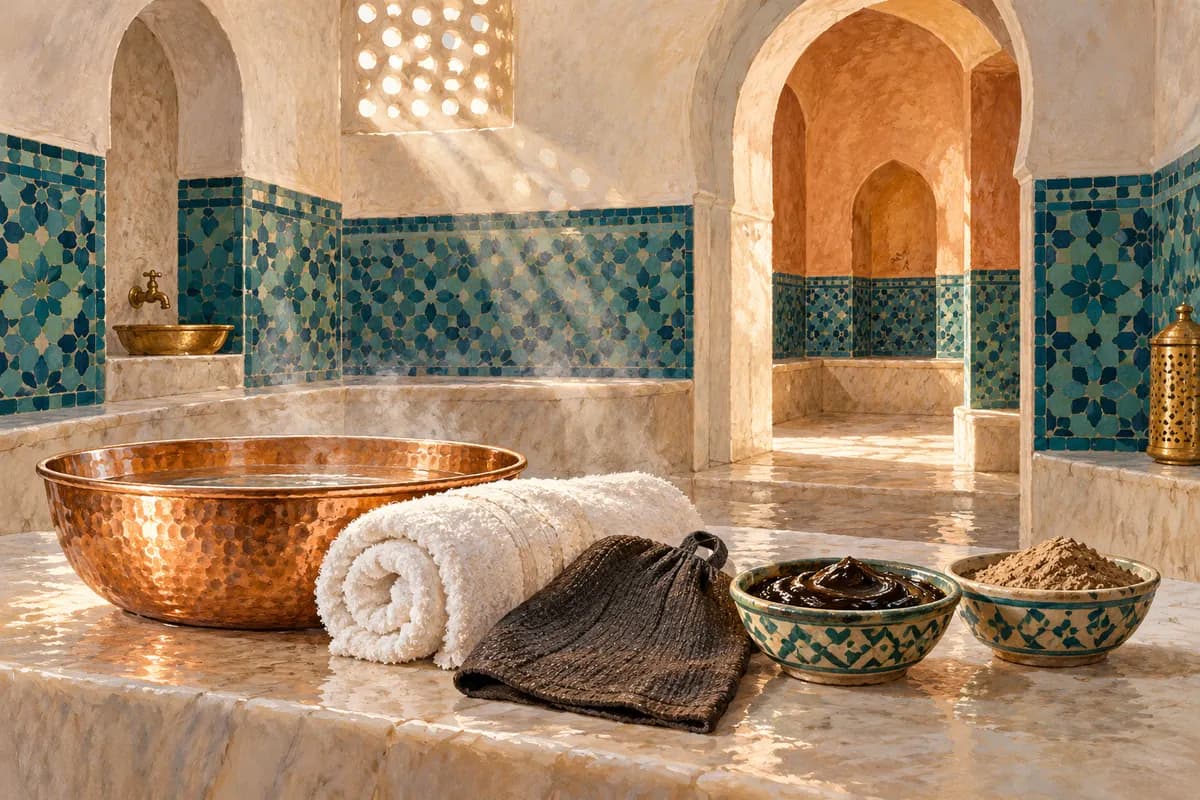
In Fez, hammams formed part of the dense urban fabric of the medina. Research by Kamal Raftani and Hassan Radoine connects them with water infrastructure, neighbourhood facilities and daily use. Seffarine illustrates the Marinid chapter of this history; Mouassine in Marrakech belongs to a later Saadian urban setting.
The bath was not simply an isolated decorated room. It relied on people who heated water, maintained the building, welcomed bathers and provided services. Its relationship with nearby streets, trades and other facilities explains more than a list of dynasties alone.
A living tradition, not a frozen scene
Social research records the hammam as a place of gathering as well as washing. Experiences differ between communities and individuals; contemporary spas add their own appointment structures and treatments. The cultural value lies partly in this capacity to change, rather than in a promise that every visit reproduces the past.
Read historic places as evidence, then choose a present-day treatment by its actual description, privacy arrangements and availability. Cultural history enriches the visit; it does not establish a venue's current opening hours or services.
Sources
- Penn, Fenwick & Limane — Gaming in the Maghreb al-Aqsa (published 5 June 2026)
- IRCAM — Nouvelles découvertes archéologiques à Aghmate
- Raftani & Radoine — The Architecture of the Hammāms of Fez, Morocco (2008), pp. 56–68
- Graiouid — Communication and the social production of space: Moroccan women and the hammam